The following are letters written by Richard Hankins, Charles E. Taylor Master Mechanic.
A Ship In The Desert
Modern day air travel has made the world a smaller place, but not necessarily less complicated. At times, it takes a bit of patience, humor, and understanding when crossing international borders into a different culture. I experienced all of these emotions recently when I was invited to take part in a ceremony, with two friends, in Amman, Jordan.
The first issue I needed to reconcile with myself is that not every Arab is a terrorist, nor is every terrorist an Arab. On the contrary, of the many, many hands that I shook in greeting, not one of them held a dagger. In fact, the only insecurity I felt at all was riding in traffic on their crowded city streets. There seemed to be three primary forces governing the flow of traffic; speed brakes, and the horns of their battle scarred cars and trucks.
Perhaps I should try to answer the question of why American Airlines Inspector Larry Turpin, retired TWA Inspector Mohamed Daoud, and I were invited to the 2006 Commencement Ceremony of the Royal Jordanian Air Academy located in Amman, Jordan. The common thread, that links us to the 1,300 graduating students and the 22 nations represented, is aviation.
Mohamed and I have received the Charles E. Taylor award, and Larry is not far behind. This national recognition by our own Federal Aviation Administration was our credentials to be invited to the ceremony, and tour of the teaching facility the following day. Our FAA is considered the gold standard of the world in aviation and flight standards.
It was an even greater honor to present an engraved wall plaque to Director General Mohammed Khawaldeh and the Royal Jordanian Air Academy commending the past, present and future graduates for their contribution to aviation in the world. Captain Khawaldeh responded with a presentation to us of a beautiful mounted insignia of the Academy, that belongs to all of us Americans.
We went to Amman as representatives, by association, of our profession, our company and our country. Peace is achieved through trust. Trust is gained through an honest exchange of knowledge and respect, and friendship is a natural outgrowth. Our "new firends" immediately invited us to return. Will I return? Of course, if God wills it. I want to fly 200 feet below sea level, and not get wet. You can do that at the Dead Sea.
========================
History Now And Then
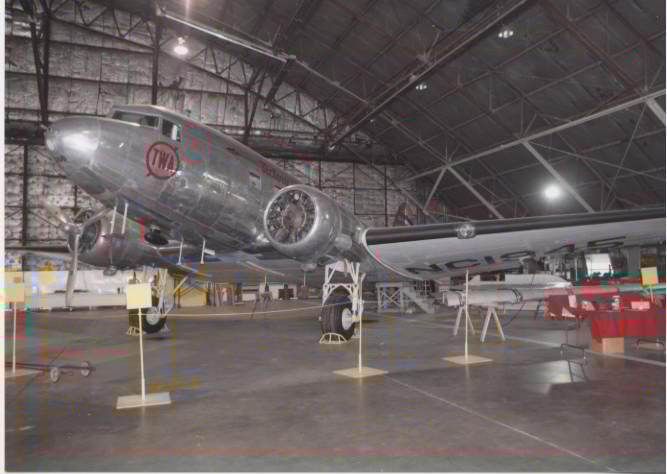
In the heart of the mid-west, you will find Kansas City, Mo. In the heart of Kansas City, you will find aviation. A closer look will reveal both the old and the new. A modern air terminal at MCI with an eye to the future, but not without a rich heritage in the past. There is an air museum at the old municipal airport that proudly displays flying models of yesteryear's glory. There is an abundance of men and women, with a love for flying as it used to be and a vision for the future, that call the Kansas City area home.
Go back with me to the beginning over a century ago to Kitty Hawk, N.C. Dec. 17, 1903, where the first powered flight took place. That is a well know fact. A lesser known fact is that the two aviators, Orville and Wilbur Wright, were bicycle mechanics by trade with a vision for flying. They designed, built and flew a number of powerless prototypes preceding the famous Wright Flyer. An even lesser known fact is that neither Orville or Wilbur built the first successful aircraft engine, although they did establish desirable criteria.
After rejection of their concept for an aircraft engine by corporate automobile manufacturers, Orville and Wilbur turned internally to the ingenuity of a machinist employee in their bicycle shop. Six weeks later Mr. Charles E. Taylor had completed and tested the first successful aircraft engine that made history that cold morning on December 17, 1903.
Charles E. Taylor went unrecognized for his role as an early aviation pioneer until 1993, when the Federal Aviation Administration instituted a recognition for the unsung heroes with tools in their pockets and grime on their hands; the aircraft mechanics. They then gave this award Mr. Charles E. Taylor's name.
The FAA did not make it easy! Fifty years in the aviation field, with thirty of those years as a licensed mechanic is just one of those requirements.
Now, back to the present. American Airlines' MCI base boasts fourteen recipients of the distinguished Charles E. Taylor Award, which is somewhat akin to the aircraft mechanic's hall of fame. Their names are listed in a leather bound ledger in the FAA National Headquarters in Washington, DC. Five of these men continue to work at the MCI Maintenance Base; Inspectors Preston Jones and Dick Hankins, Lead Systems Technicians Virgil Doyle and Bernard Koetting and AMT Richard Wilson.
"You must enjoy what you do." observed one lady. "Well said Beulah!"